Zelos is Korvantis's retail intelligence platform. Its AI learns from a retailer's own operational history to anticipate sales, identify situations that need attention and support decisions across purchasing, inventory, losses and campaigns. The work does not stop at a forecast: Zelos follows an action through to its outcome.
That is the product's strength. Instead of giving a generic answer about what a store should do, it considers the products and stores in that operation. Teams receive a recommendation while there is still time to act, along with the information needed to review it. The retailer can then check what actually happened.
AI trained on the retailer's own reality
Every retail chain has its own sales behavior, product mix, commercial calendar and inventory dynamics. Zelos uses operational history to train forecasting models that recognize those patterns. Forecasts are produced in the context of each product and store and presented as ranges of possible outcomes, because a single number cannot express all the uncertainty in retail.
Training is one part of a larger system. Before it happens, data from different sources must be organized, reconciled and checked. Afterward, the model is tested on periods it did not see during training. Zelos compares its forecasts with simpler benchmarks and examines performance across different kinds of products. A new model has to demonstrate value before it influences decisions.
Generative AI has a different role in Zelos: it helps summarize the day, explain alerts and draft campaign communications. It does not invent operational calculations. The numbers in those texts come from the product's data and engine and are checked.
How intelligence reaches a decision
Zelos is structured to connect five stages:
- Understand the data. It brings together sales, products, stores, inventory and expiration dates, keeping confirmed information distinct from what still needs checking.
- Anticipate. Models trained on the chain's history project sales and identify situations such as possible excess, loss risk or stockouts.
- Recommend. The engine connects a forecast to a concrete case and presents a possible course of action with context.
- Mobilize the operation. The suggestion reaches the people responsible for checking, deciding, pricing, approving and executing. Zelos shows the action's status at every stage.
- Measure and learn. It records the recommendation, human decision, execution and observed result. Those records help assess the effect of an action and reveal where the process needs improvement.
This design separates what AI estimates, what the engine recommends, what a person decides and what the operation does. That makes intelligence usable in daily work and gives managers a clear trail for reviewing results.
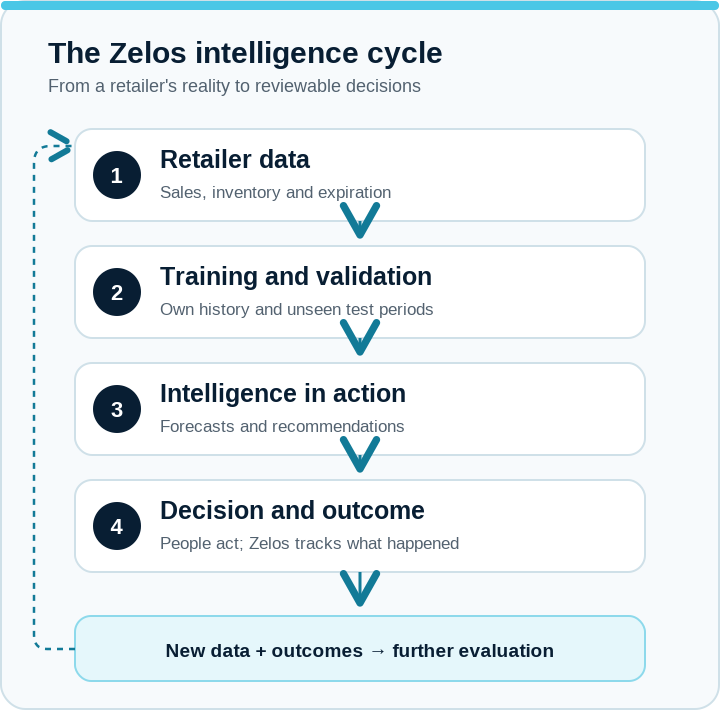
The Zelos AI cycle, from a retailer's history to the next evaluation.
A concrete case: acting before expiration
Imagine a product batch approaching its expiration date. Zelos considers the available information about its deadline, inventory and sales pace, flags the case for the team and presents options for review. The decision is made at the batch level: another batch of the same product may have a different deadline and call for a different response.
After checking the information, the team may choose a campaign, repurposing, donation or a documented decision to take no action. A campaign moves through the people responsible for pricing, approval and store preparation. Zelos tracks its progress, including proposals returned for revision and tasks still pending. People remain responsible for carrying out the action in the retailer's operational system.
At closure, the product distinguishes the value at risk, the recommendation's estimated benefit and the result actually observed. A flagged batch may sell without intervention; an approved action may never happen. Those differences are part of the learning process and prevent potential savings from being presented as realized savings.
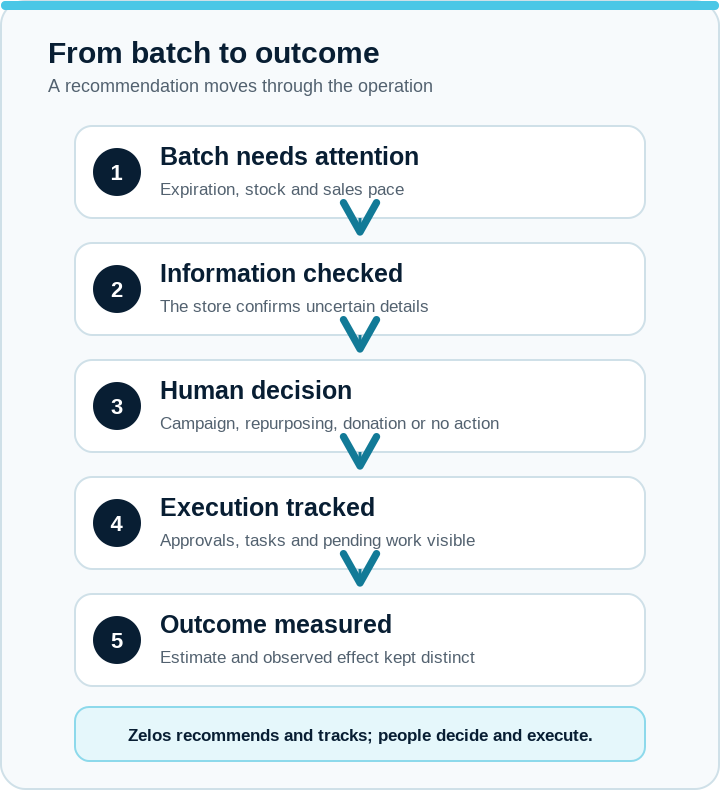
The batch moves through the teams until the action and its effect can be checked.
Continuous improvement with safeguards
Retail conditions change: new products arrive, campaigns shift sales patterns and customer behavior evolves. Zelos's AI is therefore designed around a controlled cycle of training, testing, monitoring and updating, using new operational data as it becomes available.
When a new training run or a different model is proposed, its performance is compared with the version already in use on data it did not see during training. A meaningful change is observed before it takes over operational decisions. If the new version does not show sufficient improvement, the previous one remains. Versions and evaluations are recorded so the decision can be reviewed.
Action outcomes also inform improvement work: they help identify unhelpful alerts, data that needed checking and recommendations that did not have the expected effect. Continuous learning means measuring, correcting and validating again; it does not mean allowing a model to change store rules on its own.
The power of five connected areas
Zelos brings together Sales Forecasting, Loss Prevention, Smart Purchasing, Smart Inventory and Campaigns. Each area addresses a different need, while sharing the same cycle of intelligence and execution. A forecast can support purchasing; an inventory signal can trigger a check; a batch at risk can lead to a commercial action and later to a measured outcome.
This structure broadens the potential impact. In stores, it gives teams time and focus for the work that matters. For managers, it provides visibility into decisions, pending tasks and team adoption. For the business, it creates a way to test whether actions reduce losses, excess or stockouts, including the cost of taking those actions. The size of that impact depends on each retailer's data and execution and must be demonstrated in practice.
Zelos is built to bring AI to the point where it can create value: a clear operational decision, made in time and followed through to its outcome. If you want to explore how this intelligence could work with your chain's data, talk to Korvantis.